
ECOLOGY

ecology - environment - nature - habitat - gaia - permaculture

  • Increase font size
  • Default font size
  • Decrease font size
Home Political Ecology
POLITICAL ECOLOGY

Climate and Democracy

E-mail Print PDF
Peter Burnell

Climate and democracyThe science of climate change and human responsibility, the economics of addressing the problem, the justice dimension and, even, implications for North-South relations have all received substantial exposure in public debate and specialized technical, policy, and academic literatures. We also hear about the imperative to “climate-proof” society, the poor, and even the state. Occasionally we are told the “right political framework” is needed, usually meaning an improvement on the Kyoto Protocol and national legislation for regulating energy use.

A surprising omission is a balanced inquiry into what climate change and its effects mean for democratization, and what democratization could mean for mitigating greenhouse gas emissions and climate adaptation. Democratization here means movement toward something like actually existing liberal democracy, present in many countries, not theoretical models of deliberative democracy, radical participatory democracy, or “eco-democracy”. Just as global warming has become headline news, so another but more celebrated phenomenon of recent times has been a wave of democratization, starting in southern Europe in the 1970s, subsequently embracing Latin America, Central and Eastern Europe, and sizeable parts of Africa and Asia, too. Hardly less eye-catching, however, is the wave’s recent slowing to a halt and, by some accounts, partial retreat.

Read more...
 

Joel Kovel fired from Bard College for anti-Zionism

E-mail Print PDF

Joel Kovel fired from Bard College for anti-Zionism

STATEMENT OF JOEL KOVEL REGARDING HIS TERMINATION BY BARD COLLEGE

Introduction

Joel KovelIn January, 1988, I was appointed to the Alger Hiss Chair of Social Studies at Bard College. As this was a Presidential appointment outside the tenure system, I have served under a series of contracts. The last of these was half-time (one semester on, one off, with half salary and full benefits year-round), effective from July 1, 2004, to June 30, 2009. On February 7 I received a letter from Michèle Dominy, Dean of the College, informing me that my contract would not be renewed this July 1 and that I would be moved to emeritus status as of that day. She wrote that this decision was made by President Botstein, Executive Vice-President Papadimitriou and herself, in consultation with members of the Faculty Senate.

This document argues that this termination of service is prejudicial and motivated neither by intellectual nor pedagogic considerations, but by political values, principally stemming from differences between myself and the Bard administration on the issue of Zionism. There is of course much more to my years at Bard than this, including another controversial subject, my work on ecosocialism (The Enemy of Nature). However, the evidence shows a pattern of conflict over Zionism only too reminiscent of innumerable instances in this country in which critics of Israel have been made to pay, often with their careers, for speaking out. In this instance the process culminated in a deeply flawed evaluation process which was used to justify my termination from the faculty.

Read more...
 

Eco-Socialism & Green Socialism

E-mail Print PDF

Science & Equality demand Climate Socialism for Climate Crisis

Green socialismScience and equality in the face of a worsening Climate Emergency dictate Eco-Socialism, Climate Socialism and Green Socialism to save Humanity and the Biosphere. Unaddressed man-made climate change is set to kill 10 billion people this century. Already the species extinction rate is 100-1000 times greater than normal. Sloppy, non-scientist arguments about the asserted greater economic efficiency of capitalism fall flat in the face of capitalism’s failure to address the acute problem of man-made climate change that is increasingly impacting a global avoidable mortality holocaust in which 18 million people die avoidably each year in the Developing World (excluding China).

The purpose of a "society" is surely the common good, but capitalists justify the increasing proportion of the cake taken by the wealthy since the 1960s by the claim that capitalism is superior to socialism in wealth creation (for a discussion of the increasing proportion of the cake taken by the rich see Gavin Kelly, “Wanted: a new purpose for British capitalism” (New Statesman, 16 February 2011).

Green earthHowever man-made climate change has radically changed the equation even if the politicians, media, voters and Capitalist Establishment of the Western Murdochracies and Lobbyocracies haven't yet got the message due to Mainstream lying by omission, lying by commission and remorseless obfuscation (for details see “Mainstream media censorship” and “Mainstream media lying” websites).

Thus top climate scientists argue for drastic economic decarburization if the world is to avoid a disastrous 2C temperature rise (EU policy). According to Professor Schellnhuber (Potsdam Institute, Germany) the World must achieve zero (0) carbon dioxide (CO2) emissions by 2050 and (all men being equal with equal shares in atmospheric pollution) that means that high per capita polluters such as the US and Australia must reach zero by 2020 with India able to increase pollution before finally ceasing by 2050.

Read more...
 

AN ECOSOCIALIST MANIFESTO

E-mail Print PDF


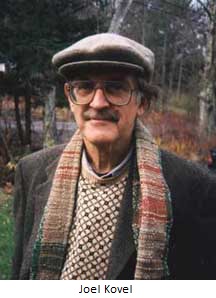
Joel Kovel
The idea
for this ecosocialist manifesto was jointly launched by Joel Kovel and Michael Lowy, at a September, 2001, workshop on ecology and socialism held at Vincennes, near Paris. We all suffer from a chronic case of Gramsci's paradox, of living in a time whose old order is dying (and taking civilization with it) while the new one does not seem able to be born. But at least it can be announced. The deepest shadow that hangs over us is neither terror, environmental collapse, nor global recession. It is the internalized fatalism that holds there is no possible alternative to capital’s world order. And so we wished to set an example of a kind of speech that deliberately negates the current mood of anxious compromise and passive acquiescence.

This manifesto nevertheless lacks the audacity of that of 1848, for ecosocialism is not yet a spectre, nor is it grounded in any concrete party or movement. It is only a line of reasoning, based on a reading of the present crisis and the necessary conditions for overcoming it. We make no claims of omniscience. Far from it, our goal is to invite dialogue, debate, emendation, above all, a sense of how this notion can be further realized. Innumerable points of resistance arise spontaneously across the chaotic ecumene of global capital. Many are immanently ecosocialist in content. How can these be gathered? Can we envision an "ecosocialist international?" Can the spectre be brought into being?
 

 Manifesto 

Michael LowyThe twenty-first century opens on a catastrophic note, with an unprecedented degree of ecological breakdown and a chaotic world order beset with terror and clusters of low-grade, disintegrative warfare that spread like gangrene across great swathes of the planet--viz., central Africa, the Middle East, Northwestern South America--and reverberate throughout the nations.

In our view, the crises of ecology and those of societal breakdown are profoundly interrelated and should be seen as different manifestations of the same structural forces. The former broadly stems from rampant industrialization that overwhelms the earth's capacity to buffer and contain ecological destabilization. The latter stems from the form of imperialism known as globalization, with its disintegrative effects on societies that stand in its path. Moreover, these underlying forces are essentially different aspects of the same drive, which must be identified as the central dynamic that moves the whole: the expansion of the world capitalist system. 

We reject all euphemisms or propagandistic softening of the brutality of this regime: all greenwashing of its ecological costs, all mystification of the human costs under the names of democracy and human rights. We insist instead upon looking at capital from the standpoint of what it has really done.

Read more...
 

Ecological Revolution for Our Time

E-mail Print PDF

Ecological Revolution for Our Time
by Simon Butler

John Bellamy Foster. The Ecological Revolution: Making Peace with the Planet. New York: Monthly Review Press, 2009. 328 pp.

The-Ecological-RevolutionKarl Marx and Frederick Engels famously urged the world's workers to unite because they had a world to win, and nothing to lose but their chains. Today, the reality of climate change and worsening environmental breakdowns globally adds a further vital dimension to this vision of human liberation. We still have a world to win -- but we also have a world to lose.

The ecological crisis is not simply the result of poor planning or bad decisions. Nor is it an unforeseeable accident. It's the inevitable outcome of an unjust economic and social system that puts business profits before all else -- even as it undermines the natural basis of life itself.

With his previous books, such as Marx's Ecology and The Vulnerable Planet, and as the editor of the US-based Marxist journal Monthly Review, John Bellamy Foster has established a well-earned reputation as one of the world's most persuasive voices arguing for fundamental social change to tackle the looming ecological catastrophe.

His new book, The Ecological Revolution, could not have been published at a more timely moment. It argues a solution to the ecological crisis "is now either revolutionary or it is false."

The Vulnerable PlanetFoster draws on the warnings from leading environmentalists such as Bill McKibben, James Hansen, and Lester Brown among others.

McKibben has said we have now entered the "Oh Shit" era of global warming -- it's already too late to stop the harsh impacts of climate change entirely. NASA scientist Hansen has said the rapid pace of climate change amounts to a "planetary emergency."

In his 2008 book Plan B 3.0, Brown said: "We are crossing natural thresholds that we cannot see and violating deadlines that we do not recognize. Nature is the time keeper, but we cannot see the clock. . . . We are in a race between tipping points in the earth's natural systems and those in the world's political systems. Which will tip first?" 

The Ecological Revolution is a call for urgent action and an intervention into the debates about the kind of action needed to win this "race."

The dwindling band of climate change deniers aside, general awareness of the extent of environmental decay is more widespread than ever -- even among the world's elites. The upshot is that two distinct visions of ecological revolution have emerged.

The first tries to paint business as usual economics green. The second, following Che Guevara's maxim, holds it must be a genuine eco-social revolution or it's a make-believe revolution.

"The conflict between these two opposing approaches to ecological revolution," writes Foster, "can now be considered the central problem facing environmental social science today."

Read more...
 

John Bellamy Foster on `Marx's Ecology' and `The Ecological Revolution'

E-mail Print PDF

John Bellamy Foster on `Marx's Ecology' and `The Ecological Revolution'

John Bellamy Foster interviewed by Aleix Bombila

The Ecological Revolution - John Bellamy FosterJohn Bellamy Foster is editor of the US socialist journal Monthly Review and author of Marx's Ecology and The Ecological Revolution. Aleix Bombila writes for En Lucha (Spain). This interview first appeared in English at MRZine.

En Lucha: In your book Marx's Ecology you argue that Marxism has a lot to offer to the ecologist movement. What kind of united work can be established between Marxists and ecologists?

John Bellamy Foster: I think it is important to recognise that Marxists and ecologists are not entirely different groups. Of course it is true that there have been Reds who have been anti-ecological and Greens who have been anti-Marxist. But it is not uncommon for the two to overlap, and increasingly to converge. Many socialists are environmentalists and many environmentalists are socialists. Indeed, there is a sense in which Marxism and ecology, both classically and today, lead to the same conclusion. For Marx, the goal was the creation of a society in which the metabolic relation between humanity and nature (i.e. production) was rationally regulated by the associated producers. The original title of my book that you refer to was supposed to be Marx and Ecology, but I changed it to Marx's Ecology because of the depth of Marx's ecological conceptions.

I would argue that a critical Marxist approach, especially in our time, requires an ecological worldview, while a critical human ecology requires an anti-capitalist and ultimately socialist orientation (i.e., a Marxist one). In terms of united work that Marxists and ecologists can share, I would say social justice and environmental sustainability: saving humanity and saving the Earth. You can't expect to achieve one without the other, and neither is possible under the existing system.

Read more...
 

Eco-Socialism - Why we need Eco-socialism

E-mail Print PDF

Eco-Socialism

Why we need Eco-socialism

Derek Wall

In his presentation to the Socialist Resistance ‘Ecosocialism or Barbarism’ day school Dr. Derek Wall, the Male Principal Speaker of the Green Party of England and Wales argued for a re-reading of Marx to develop ecosocialist principles, for the alternative is literally unthinkable destruction. Derek Wall is a life long ecosocialist and founder of the GPEW socialist group Green Left. [1]

I would like to thank you for endorsing Joel Kovel and Michael Lowy’s Ecosocialist Manifesto: [2] it is an essential document because it argues that unlimited economic growth is unsustainable, while capitalism to survive must grow for ever. It calls for an alternative to this system of madness. Support for the Ecosocialist manifesto is therefore vital.

In a passage from Capital: Volume One, which is important for its understanding of how we can create a sustainable future, Marx links the open source principle to socialism and use - we should take what we want but nurture what we use for the benefit of the next generation:

From the standpoint of a higher economic form of society, private ownership of the globe by single individuals will appear quite absurd as private ownership of one man by another. Even a whole society, a nation, or even all simultaneously existing societies taken together, are not the owners of the globe. They are only its possessors, its usufructuries, and like boni patres familias, they must hand it down to succeeding generations in an improved condition. [3]

Read more...
 

ECO-SOCIALISM

E-mail Print PDF

EcosocialismEco-socialism, green socialism or socialist ecology is an ideology merging aspects of Marxism, socialism, green politics, ecology and alter-globalization. Eco-socialists generally believe that the expansion of the capitalist system is the cause of social exclusion, poverty, war and environmental degradation through globalization and imperialism, under the supervision of repressive states and transnational structures.[1]

Eco-socialists advocate the dismantling of capitalism and the state, focusing on collective ownership of the means of production by freely associated producers and restoration of the commons.[1]

Contents

  • 1 Ideology
  • 2 History
    • 2.1 1880s-1930s - Marx, Morris and influence on the Russian Revolution
    • 2.2 1970s-1990s - Rise of environmentalism and engagement with Marxism and 'actually existing socialism'
    • 2.3 1990s onwards - Engagement with the anti-globalization movement and The Ecosocialist Manifesto
    • 2.4 Influence on current Green and socialist movements
    • 2.5 Influence on “existing socialist” regimes
    • 2.6 Ecosocialist International Network (EIN) and other international eco-socialist organisations
  • 3 Critique of capitalist expansion and globalisation
    • 3.1 Use and exchange value
    • 3.2 The "second contradiction" of capitalism
    • 3.3 The role of the state and transstatal organisations
  • 4 Tensions within the Eco-Socialist discourse
  • 5 Critique of other forms of green politics
    • 5.1 Opposition to within-system approaches, voluntarism and technological fixes
    • 5.2 Critique of Green economics
    • 5.3 Critique of Deep Ecology
    • 5.4 Critique of bioregionalism
    • 5.5 Critique of variants of eco-feminism
    • 5.6 Critique of Social Ecology
    • 5.7 Opposition to Malthusianism and Neo-Malthusianism
    • 5.8 The "two varieties of environmentalism"
  • 6 Critique of other forms of socialism
    • 6.1 Critique of 'Actually Existing Socialisms'
    • 6.2 Critique of the wider socialist movement
  • 7 Eco-socialist strategy
    • 7.1 Agency
    • 7.2 Prefiguration
    • 7.3 Internationalization of prefiguration and the 'Eco-socialist Party'
  • 8 ’The Revolution’ and transition to eco-socialism
    • 8.1 The immediate aftermath of the revolution
    • 8.2 Transnational trade and capital reform
    • 8.3 Ecological production
    • 8.4 Commons, property and ‘usufruct’
    • 8.5 Non-violence
  • 9 Criticisms of eco-socialism
  • 10 List of eco-socialists
  • 11 See also
  • 12 References
  • 13 External links

Ideology

Part of the Politics series on
Green politics
Recycling symbol.svg Environment Portal
Politics portal

Eco-socialists are critical of many past and existing forms of both Green politics and socialism. They are often described as Red Greens - adherents to Green politics with clear anti-capitalist views, often inspired by Marxism (Red Greens should be contrasted with Blue Greens).

The term Watermelon is commonly applied, often as an insult, to describe professed Greens who seem to put "social justice" goals above ecological ones, implying they are "green on the outside but red on the inside"; the term is usually attributed to either Petr Beckmann or, more frequently, Warren T. Brookes,[2][3][4] both critics of environmentalism, and is apparently common in Australia,[5][6] New Zealand[7] and the United States[8]

A website in New Zealand, The Watermelon, uses the term as a compliment, stating that it is "green on the outside and liberal on the inside", using the term 'liberal' while also citing "socialist political leanings", reflecting the use of the term 'liberal' to describe the left-wing in many English-speaking countries.[7] Red Greens are often considered 'fundies' or 'fundamentalist greens', a term usually associated with Deep Ecology despite the fact that the German Green Party 'fundi' faction included eco-socialists, and eco-socialists in other Green Parties, like Derek Wall, have been described in the press as 'fundies'.[9][10]

Eco-socialists also criticise bureaucratic and elite theories of socialism such as Maoism, Stalinism and what other critics have termed Bureaucratic Collectivism or State Capitalism. Instead, eco-socialists focus on imbuing socialism with ecology while keeping the emancipatory goals of 'first-epoch' socialism.[1] Eco-socialists aim for a world of communal ownership of the means of production by "freely associated producers" with all forms of domination eclipsed, especially gender inequality and racism.[1]

This often includes the restoration of commons land in opposition to private property,[11] in which local control of resources valorizes the Marxist concept of use value above exchange value.[12] Practically, eco-socialists have developed different theories of ways to mobilise action on an internationalist basis, developing networks of grassroots individuals and groups that can radically transform society through non-violent "prefigurative projects" for a post-capitalist, post-statist world.[12]

History

1880s-1930s - Marx, Morris and influence on the Russian Revolution

Contrary to the depiction of Karl Marx by some environmentalists,[13] social ecologists[14] and fellow socialists[15] as a productivist who favoured the domination of nature, eco-socialists have revisited Marx's writings and believe that he "was a main originator of the ecological world-view".[12] Eco-socialist authors, like John Bellamy Foster[16] and Paul Burkett,[17] point to Marx's discussion of a "metabolic rift" between man and nature, his statement that "private ownership of the globe by single individuals will appear quite absurd as private ownership of one man by another" and his observation that a society must "hand it [the planet] down to succeeding generations in an improved condition".[18] Nonetheless, other eco-socialists feel that Marx overlooked a "recognition of nature in and for itself", ignoring its "receptivity" and treating nature as "subjected to labor from the start" in an "entirely active relationship".[12]

Therefore William Morris, the English novelist, poet and designer, is largely credited with developing key principles of what was later called eco-socialism.[19] During the 1880s and 1890s, Morris promoted his eco-socialist ideas within the Social Democratic Federation and Socialist League.[20]

Following the Russian Revolution, some environmentalists and environmental scientists attempted to integrate ecological consciousness into Bolshevism, although many such people were later purged by the Communist Party of the Soviet Union.[21] The "pre-revolutionary environmental movement", encouraged by revolutionary scientist Aleksandr Bogdanov and the Proletkul't organisation, made efforts to "integrate production with natural laws and limits" in the first decade of Soviet rule, before Joseph Stalin attacked ecologists and the science of ecology and the Soviet Union fell into the pseudo-science of the state biologist Trofim Lysenko, who "set about to rearrange the Russian map" in ignorance of environmental limits.[12]

Read more...
 
More Articles...
  • «
  •  Start 
  •  Prev 
  •  1 
  •  2 
  •  Next 
  •  End 
  • »


Page 1 of 2

Choose Language


The GURUS & ACTIVISTS