
ECOLOGY

ecology - environment - nature - habitat - gaia - permaculture

  • Increase font size
  • Default font size
  • Decrease font size
Home Habitat News
HABITAT NEWS

Berikoy Team Attended ATC Conference

E-mail Print PDF

Berikoy Team Attended ATC Conference

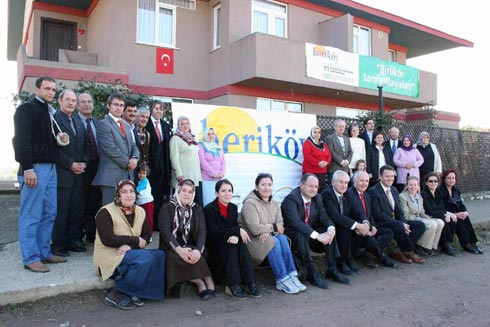
Tracy Lavin, Special to The Turkish Times-Beriköy Team members attended the American Turkish Conference in Washington, D.C. to host a workshop on sustainability with guest panelists: MIT Professor Jan Wampler; Director of Habitat for Humanity International, Tom Jones, and Owner of First Renaissance Ventures, Martin Erim. The conference coverage was hugely successful and prosperous and a thank you is owed to ATC's generous booth and workshop contribution. Additionally, Naci Saribas, Minister Counselor, Turkish Deputy Chief of Mission, is held in high esteem for his professionalism, but also his heart for Beriköy and we are gracious for his support.

Berikoy Project

You may have recently read or heard about "Beriköy: Communities Building Communities" sustainability project in Turkey. Beriköy addresses long-term sustainability in Economic, Social and Ecologic avenues and is a partnered in part by Habitat for Humanity International and CEKUL Vakfi. Beriköy was developed through Massachusetts Institute of Technology Professor Jan Wampler and students yearlong architectural workshop, which started shortly after the earthquakes in August of 1999.

Beriköy went on the road immediately following ATC with Mr. Martin Erim and Ms. Muzeyyen Akdeniz of First Renaissance Ventures, as they organized and developed Beriköy's participation in the Department of Commerce "Trade Opportunities in Turkey" conference. Beriköy was honored by a warm introduction from Mr. John Breidenstein, the Foreign Commercials Director at the US Embassy in Ankara.

Beriköy continues with its fundraising efforts and successes. Recently the Federation of Turkish American Associations became a project sponsor by donating a home for one Beriköy family. FTAA recognizes the vision of Beriköy and serves as a leading example for organizations and individuals to also sign onto Beriköy.


Dream village (Berikoy) rising in wake of quake

E-mail Print PDF

Dream village rising in wake of quake

Robert J. Sales, News Office
Beriköy

The dream of a safe new Turkish community, hatched in the wake of an earthquake that killed at least 15,000 and destroyed dozens of towns and villages, is becoming a reality for 50 displaced families this summer. 

Thanks to the skill and tenacity of MIT Professor Jan Wampler of architecture and two MIT graduates who live in Turkey, ground was broken last month for an innovative housing project near the city of Adapazari that will provide homes for the 50 families. Their homes were destroyed by the 1999 quake that measured 7.4 on the Richter scale. They have been living in tents and prefabricated housing for almost four years. 

Wampler and his former students, Rukiye Devres Unver and Barbara Brady, and students from his international workshop course toured the area after the quake, surveying the damage and talking with victims. As a result of those discussions, they compiled a list of residents' desires for their rebuilt community. 

Read more...
 

Non-Formal Education for Sustainable Development in Turkey

E-mail Print PDF

Hideki Maruyama

The United Nations Decade of Education for Sustainable Development (DESD) began in 2005. What does this term mean? What is new about ESD, and in what respects is it broader than "Education for All" and the Millennium Development Goals? The author first reviews the framework of ESD and then describes a case study of sustainability in Turkey, relating to help with recovery from an earthquake. Hideki Marayuam is a researcher at the Department for International Research and Cooperation of the National Institute for Educational Policy Research (NIER) of Japan.

Non-Formal Education for Sustainable Development in Turkey

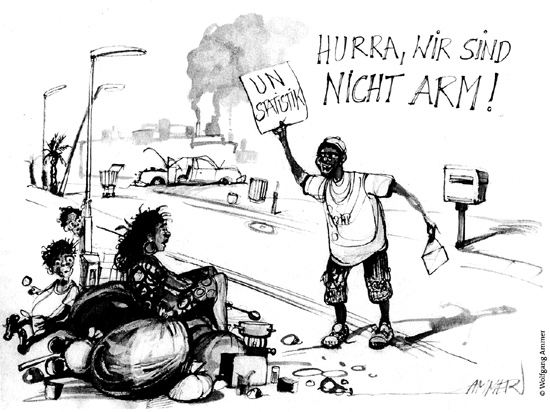
UN Statistics: Horray, we are not poor

UN Statistics: Hooray, we are not poor
Source: WELT-SICHTEN 2/3-2008, p. 54

The United Nations Decade of Education for Sustainable Development started in 2005. EFA could be more important for many countries because it shows clear numerical targets, but Education for Sustainable Development (ESD) is more ambiguous because "sustainable development is a term that everyone likes, but nobody is sure of what it means." (Daly, 1996) When development is generally mentioned, we tend to think of economic development and human development. Sustainability is often used as the term for how to make international cooperation activities continue when external funds stop. But ESD covers wider topics and contains the complex but integrated relationships among economic, ecological, social and political systems - more than education only - needed to keep economic develop ment sustainable or to nurture the sense of nature conservation. In addition to the new view and scope of ESD, the contents should be considered because necessary knowledge and skills are different across cultures. Islamic societies, for instance, may not "depend" on the global framework.

Read more...
 

Habitat for Humanity Turkey

E-mail Print PDF

Habitat for Humanity Logo

Habitat for Humanity Turkey 

Habitat for Humanity Turkey
 

Country profile
Although we work in nearly 100 countries worldwide, we do not have, at the moment, any active programme in this country.


Housing need

In Turkey, housing is a complex social issue. Thirty years ago, three quarters of the population lived in the countryside and a minority lived in major cities. Now, the situation is reverse. Most villagers who migrated to the cities looking for work could not afford decent housing so they built temporary shelters in the outskirts. These shelters soon became neighborhoods of shacks, with no piped water or electricity. Poverty and crime became main characteristics of these growing urban slums.

Into this environment of substandard housing, which ignored earthquake hazards, came the tragedies of August 1999 tremors and aftershocks. Cheaply built, illegal housing lies at the heart of that earthquake disaster. It explains why so many houses crumbled like packs of cards. Much of the housing in poorer urban areas was substandard. It was constructed from mud brick and was unable to withstand the impact of a strong tremor.

Read more...
 

WORLD URBAN FORUM 5: The Right to the City-Bridging the Urban Divide

E-mail Print PDF


World Urban Forum 5: The Right to the City-Bridging the Urban DivideIn the space of a few short years, the World Urban Forum has turned into the world's premier conference on cities. The Forum was established by the United Nations to examine one of the most pressing problems facing the world today: rapid urbanization and its impact on communities, cities, economies, climate change and policies.

Since the first meeting in Nairobi, Kenya in 2002, the Forum has grown in size and stature as it travelled to Barcelona in 2004, Vancouver 2006, and Nanjing in 2008.

With half of humanity already living in towns and cities, it is projected that in the next 50 years, two-thirds of us will be living in towns and cities. A major challenge is to minimize burgeoning poverty in cities, improve access of the urban poor to basic facilities such as shelter, clean water and sanitation and to achieve environmentally friendly, sustainable urban growth and development.

Rio de JanerioUN-HABITAT and the Government of Brazil have started preparations for the fifth session scheduled in Rio de Janeiro 22 - 26 March 2010. The Forum is one of the most open and inclusive gatherings of its kind on the international stage. It brings together government leaders, ministers, mayors, diplomats, members of national, regional and international associations of local governments, non-governmental and community organizations, professionals, academics, grassroots women's organizations, youth and slum dwellers groups as partners working for better cities. The fifth session in Rio builds on the lessons and successes of the previous four events.

"Brazil, like other countries in the world, became essentially urban during the twentieth century. Today, in Brazil, but also throughout the world, we need to rethink and renegotiate the fundamental bases of the city we want," said Marcos Caramuru de Paiva, the Brazilian Consul General in Shanghai. Speaking to delegates in Nanjing, he added: "Our home planet is only one, we change addresses but consume the same globalized products, we travel the same way, we use the same natural resources and we develop together."

The theme for Rio 2010, The right to the City - “ bridging the urban divide is in harmony with UN-HABITAT's flagship report, State of the World's Cities 2010-2011.

 
  • «
  •  Start 
  •  Prev 
  •  1 
  •  2 
  •  Next 
  •  End 
  • »


Page 1 of 2

Choose Language


The GURUS & ACTIVISTS