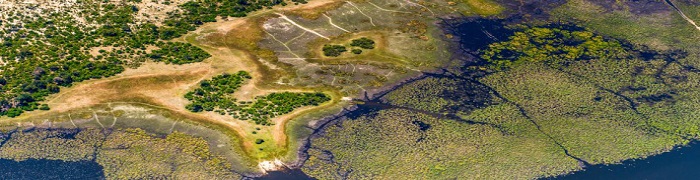
The linkages between biodiversity, climate change and sustainable land management
From the Rio Conventions’ Ecosystems Pavilion: It is now widely recognized that climate change, land degradation and biodiversity are interconnected, not only through effects of climate change on biodiversity and land management, but also through changes in biodiversity and ecosystem functioning that affect climate change. The carbon cycle and the water cycle, arguably the two most important large-scale processes for life on Earth, both depend on biodiversity – at genetic, species, and ecosystem levels and can yield feedbacks to climate change.
Maintaining and restoring healthy ecosystems plays a key role in adapting to and mitigating climate change through biodiversity conservation, sustainable use and sustainable land management and yields multiple environmental, economic and social benefits.
Ecosystem-based approaches provide an important route to sustainable action and represent a vital insurance policy against irreversible damage from climate change, whereas failure to acknowledge the relationship between climate change and biodiversity and failure to act swiftly and in an integrated manner could undermine efforts for improvements in both areas.
However, enormous pressures have been put on ecosystems to support the ever-growing demand for natural resources over recent years. Ecosystem services that are central to adaptation include goods, such as food, fodder and pharmaceutical products, and services, such as nutrient cycling and hydrological flows.
This was discussed on Monday, 18 October, 2010 ion Nagoya, Japan, during the tenth meeting of the Conference of the Parties to the Convention on Biological Diversity.
Read more...
Turkey: “May Our Forests Never Thin Out”
By J.E. Nigros

The people of Turkey have long been aware of the unique biodiversity of their country and the importance of preserving natural habitats. More than a millennium ago, the folk poet Dede Korkut wrote this prayer:
May our big shade tree never be cut down
May our forests never thin out
May our clear running streams never dry up
May we never be deprived of hope
May our wings never be broken
May our household fire keep burning
While Dede Korkut’s prayer seems to consign the fate of the environment to Allah and to chance, modern Turkish people know they must pass laws and enforce environmental policies to protect their environment.
Since the 1950’s, Turkey has been developing its environmental policies. Since 1997, the rules of the Convention of Biological Diversity have been in force. Turkey is a party to all relevant international conventions having to do with the conservation of biodiversity. According to the ever-evolving document, the National Biodiversity Strategy and Action Plan, Turkish legislation, however, has never been “harmonized from a consistent environmental point of view which presents frequent problems of overlap and lack of legal mandates for institutions.”
Read more...
World's biodiversity 'crisis' needs action, says UN
The UN has launched the International Year of Biodiversity, warning that the ongoing loss of species around the world is affecting human well-being.
Eight years ago, governments pledged to reduce the rate of biodiversity loss by 2010, but the pledge will not be met. The expansion of human cities, farming and infrastructure is the main reason. Speaking at the launch in Berlin, German premier Angela Merkel urged the establishment of a new panel to collate scientific findings on the issue.
Achim Steiner, executive director of the UN Environment Programme (UNEP), urged governments and their leaders to renew their commitment to curbing biodiversity loss even though the 2010 goal will be missed. "The urgency of the situation demands that as a global community we not only reverse the rate of loss, but that we stop the loss altogether and begin restoring the ecological infrastructure that has been damaged and degraded over the previous century or so," he said.
Read more...
Upcoming Ethnobiology Course in Turkey
Kars, Turkey: As part of our international program, GDF is co-organizing an ethnobiological research methods short course with a particular focus on applied research in Turkey, Kyrgyzstan and Tajikistan. The course, to be held 13 - 21 September 2010 in Kars, will explore how global trends are impacting local communities and how researchers can interact with these communities in transition, helping them to draw upon their biocultural diversity to adapt to a changing world. Gary Martin will be conducting the course in collaboration with Dr. Füsun Ertuğ and Dr. Çagan Şekercioğlu (KuzeyDoga Society and Stanford University). Interested students can find further details on how to apply at the Biocultural Diversity Learning Network.
http://www.global-diversity.org/upcoming-ethnobiology-course-turkey
Biodiversity, Ecology, and Ecosystem Services - Impact Assessment Considerations/Approaches
Definitions
Biological diversity, or ‘biodiversity’, simply means the variety of life on Earth. Stated another way, it refers to the variability among living organisms from all sources including, inter alia, terrestrial, marine and other aquatic ecosystems and the ecological complexes of which they are part; this includes diversity within species, between species and of ecosystems.
Ecology is the study of the relationships and interactions between living organisms and their natural or developed environment.
Ecosystem services are the benefits of nature to people - households, communities and economies. They comprise provisioning, regulating, supporting and cultural services.
Ecological Footprint of an individual, a city, a country, or humanity is a measure of how much productive land and water they require to produce all the resources they consume and to absorb all the waste they generate, using prevailing technology. The term was coined by William E. Rees and Mathis Wackernagel in the early 1990s. The Ecological Footprint is measured in global hectares. Today, humanity's Ecological Footprint is over 23% larger than the planet can regenerate. (http://www.footprintnetwork.org/) In other words, it now takes more than one year and two months for the Earth to regenerate what we use in a single year. We maintain this overshoot by liquidating the planet's ecological resources.
Read more...
IYB Travelling Exhibition
UNESCO, in collaboration with the Secretariat of the Convention on Biological Diversity (CBD), the Global Environment Facility (GEF), the United Nations Environment Programme (UNEP) and Centre Sciences, Orléans - a French resource centre specialized in the production of travelling scientific exhibitions - have joined efforts to create a travelling exhibition to convey the key IYB messages on biodiversity.
The exhibition aims to enhance public awareness of the importance of conserving biodiversity, of the threats to biodiversity and demonstrates how the global community is working to ensure its conservation and sustainable use now and in the future. In particular, the exhibition explores the multiple aspects of biodiversity contributing to human well-being and describes the direct and indirect factors contributing to biodiversity loss. There is special emphasis on the economic aspects of biodiversity and the links between cultural and biological diversity. The exhibit is intended for multiple audiences, including policy- and decision-makers, conservation practitioners, museums and educational institutions. The use of simple language and attractive visual elements contribute to making the exhibition equally accessible to a wider public.
The exhibition, in English and French, organized around 7 themes comprises in total 42 panels with 6 panels per theme. The physical copy of the exhibition will be enhanced throughout the IYB with interactive elements. Exhibitors are invited to display local examples of biodiversity alongside the panels.
Related links
Biodiversity Beyond 2010: Missed Targets, New Opportunities

Date: 2-4 November 2010
Venue: Royal Marine Hotel, Dun Laoghaire, Republic of Ireland
BACKGROUND
In the International Year of Biodiversity what do we have to celebrate? What has been achieved? What targets have been met? What still needs to be done? What tools are available to improve biodiversity conservation in the future?
Heads of State and Government undertook in 2001 to halt the decline of biodiversity in the EU by 2010 and to restore habitats and natural systems. In 2002, they also joined some 130 world leaders in agreeing to significantly reduce the rate of biodiversity loss globally by 2010.
In May 2006, the European Commission adopted a communication on "Halting Biodiversity Loss by 2010 – and Beyond: Sustaining ecosystem services for human well-being". The Communication underlined the importance of biodiversity protection as a pre-requisite for sustainable development, as well as setting out a detailed EU Biodiversity Action Plan to achieve this.
Read more...
International Year of Biodiversity
The UN declared 2010 the International Year of Biodiversity (IYB). Throughout the year countless initiatives will be organized to disseminate information, promote the protection of biodiversity and encourage organizations, institutions, companies and individuals to take direct action to reduce the constant loss of biological diversity worldwide. The celebrations for the International Year of Biodiversity are led by the Secretariat of the Convention on Biological Diversity (CBD). Countdown 2010 is a partner of the CBD for the IYB.
In only a few years of activity, Countdown 2010 has been able to mobilize an increasing number of actors ranging from local authorities and businesses to civil society organizations. With a powerful network of nearly 1,000 partners, Countdown 2010 is one of the leading initiatives mobilizing action for the 2010 Target. Through its wide and well-established network, Countdown 2010 will be a key global actor for IYB in Europe and around the world. Countdown 2010 and its partners will provide one of the main information channels and will be a major vehicle for reaching target groups worldwide.

Objectives of IYB
- Raise awareness of the importance of conserving biodiversity for human well-being and promote understanding of the economic value of biodiversity
- Enhance public knowledge of the threats to biodiversity and means to conserve it
- Encourage organizations (and through them individuals) to take direct or indirect biodiversity conservation activities
- Celebrate the achievements of Countdown 2010 partners and other stakeholders
- Reporting on the possible failures for not achieving the Target
- Prepare the ground for communicating the post-2010 target(s)
Find out more what you can do to celebrate the IYB!
You can find more information on the International Year of Biodiversity on the following websites:
GLOBIO

What is GLOBIO?
GLOBIO is a modelling framework to calculate the impact of five environmental drivers on land biodiversity for past, present and future.
 Land use, here forestry, is one of the environmental drivers impacting biodiversity.
GLOBIO is based on cause-effect relationships, derived from the literature. To use GLOBIO no detailed species data are needed. Instead, the model uses spatial information on environmental drivers as input. This input is mainly derived from the Integrated Model to Assess the Global Environment (IMAGE).
The current version of GLOBIO, GLOBIO3, focuses on the terrestrial part of the globe. A module for the freshwater aquatic environment is under development (GLOBIO-aquatic). The Sea Around Us Project of the University of British Colombia (UBC) has developed a similar model for marine ecosystems: EcoOcean.
The information under this menu item refers to the current version of the model: GLOBIO3.
Read more...
|
|